How to
Couples fitness challenge: 12 ideas that stay fair when you are not the same
Couples fitness challenge ideas that stay fair when one of you runs and one of you lifts, or you wear different watches: shared goals, fair duels and daily pacts.
Quick answer
Make it fair before you make it hard. If you are at different fitness levels or wear different devices, do not race raw totals: team up on one shared target, score each of you against your own normal, or race active minutes, which key off each person's heart rate. Good couples challenges include a shared weekly kilometre goal, a streak you both have to keep, a beat-your-own-average duel and a weekly race with an honest head start.
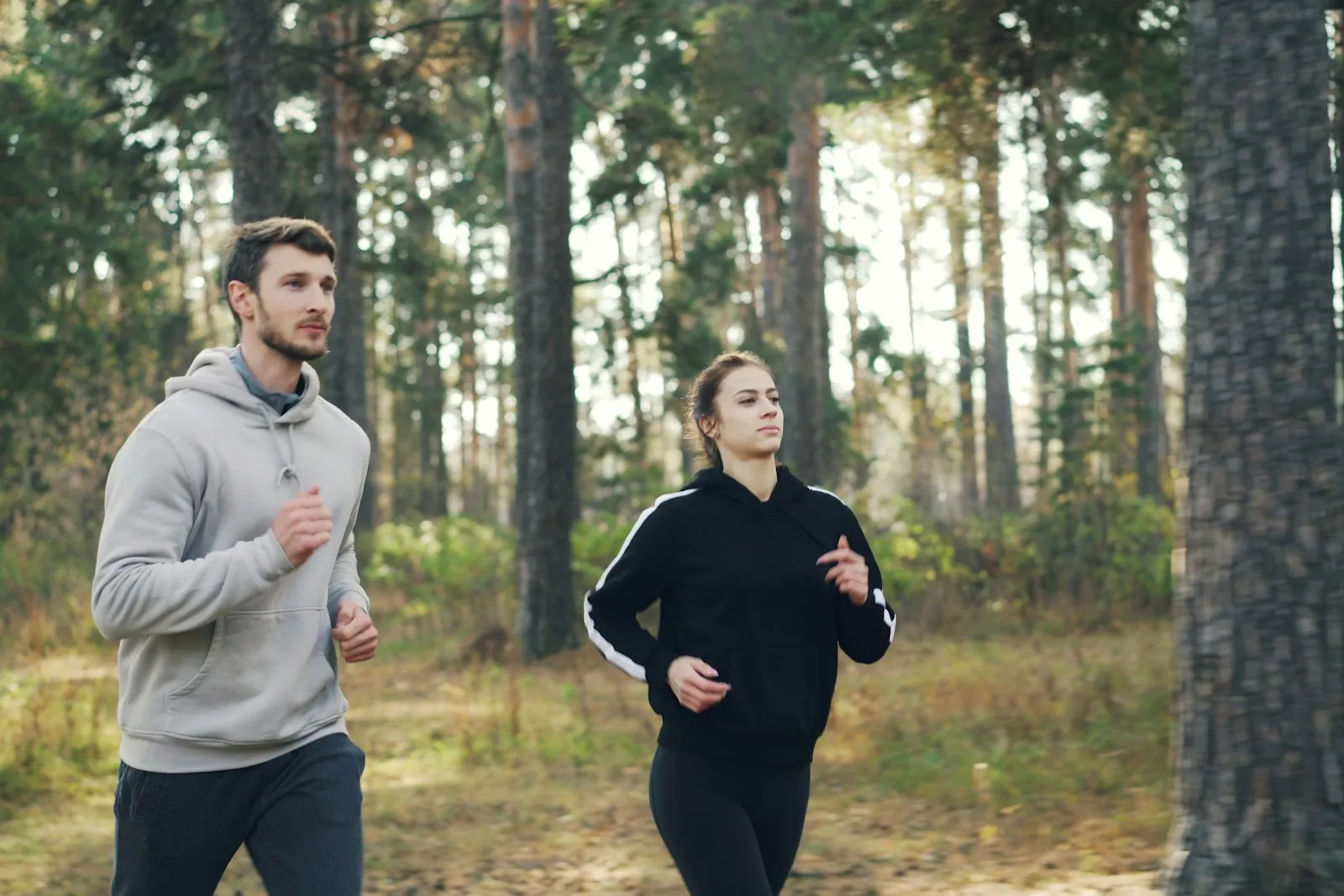
One of you runs half marathons. The other is three weeks into a gym habit and wears a different watch. You agree on a fitness challenge, and by the second evening it is obvious who is going to win every single day. That is not a challenge. It is a chore with a scoreboard.
A partner is the best training buddy you will ever have and the worst possible opponent, unless the format is fair. Here is how to pick one, and twelve ideas that hold up when the two of you are not the same.
Why training together works, and when it backfires
The case for doing this as a couple is strong. A study that followed 3,722 couples over 50 found people were far more likely to become active when their partner did too: 67 percent of men whose partner took up activity followed, against 26 percent of men whose partner stayed inactive, with near-identical numbers for women. A separate study of more than 3,000 married pairs found that when one spouse’s activity changed, the other’s tended to move with it.
The pull works best when the gap is small. In the Kohler effect experiments, people paired with a partner who was a little better exercised roughly twice as long as people working out alone. A partner who is miles ahead tends to do the opposite: you stop trying to keep up, and then you stop. That is the failure mode of the runner and the beginner racing raw distance.
There is a quieter catch, too. A 2024 study of adults in their fifties to seventies found that couples in a walking program together logged fewer steps than people taking part on their own, and hit high step targets less often. One likely reason: walking side by side, the faster partner slows down. None of this argues against training together. It argues for picking formats that let each of you go at your own pace and still share the result.
Pick the format first
Couples challenge formats, and when each one is fair
| Format | Fair across fitness levels? | Fair across devices? | Best for |
|---|---|---|---|
| Shared weekly goal | Yes, you add up rather than compete | Yes, in kilometres or minutes | Couples who hate losing to each other |
| Two-person streak | Yes, it only asks you both to show up | Yes | Building one habit together |
| Beat your own average | Yes, each of you races your own normal | Yes, each device is compared with itself | One fit partner, one starting out |
| Active-minutes race | Mostly, minutes key off your own heart rate | Mostly | Different sports |
| Head-start duel | Yes, if the handicap is honest | Depends on the unit | Competitive couples |
| Raw step or distance race | No, the fitter partner wins daily | Steps no, distance mostly | Two people at the same level |
The top three rows are the safe defaults for most couples, and the bottom row is the tempting one. If you only change one thing, change that.
Team up: challenges you win together
- The shared weekly kilometre goal. Add your distance together toward one target, set so you both have to pitch in. Neither of you can carry it alone, and nobody loses to anybody.
- The two-person streak. The streak only survives if you both log at least 15 active minutes that day. It turns “did you go?” into “did we go?”, which is the whole point.
- The joint 150. You each hit the 150 minutes of moderate activity a week the WHO recommends for adults, and you only celebrate when both of you get there.
- The weekly new thing. Once a week, try an activity neither of you has done: a climbing wall, a dance class, a kayak. Couples who did novel, slightly thrilling tasks together reported a bigger lift in relationship quality than couples who did something routine, in a well-known set of experiments.
Race fairly: duels with an honest handicap
- Beat your own average. Each of you takes your last four weeks of active minutes as a baseline, and whoever beats their own number by the bigger percentage wins the week. The runner and the beginner start level.
- The active-minutes race. Many trackers count active minutes against your own heart rate zones, so a hard hour of lifting and a steady run both register as effort. It is the fairest raw race for two different sports, which we explain in why active minutes travel between devices.
- The head-start duel. Race distance or minutes, but the fitter partner spots the other a head start agreed on Sunday night. Adjust it every week until the result is a coin toss.
- The personal-best swap. Each of you picks one personal best in your own sport, a 5 km time, a deadlift, a longest walk, and the first to beat theirs wins dinner.

Build the habit: small daily pacts
- The after-dinner walk. Ten minutes out of the door after your evening meal, together. Light walking after eating helps blunt the rise in blood sugar, and it is the easiest win on this list. Our walking challenge guide has more formats like it.
- The lights-out bet. Agree a bedtime and score average hours asleep over the week, never a brand’s sleep score, since sleep scores do not compare between devices.
- Alternate picks. Take turns choosing the week’s workout. You each get dragged into the other’s sport once a week, which keeps it novel and keeps it fair.
- The no-car errands week. Every errand within a couple of kilometres happens on foot or by bike, and you count the trips together.
Keep the stakes small and domestic: the loser cooks Friday, or does the dishes for a week. Framing the stake as something to lose works better than a prize, for reasons we cover in how to run a fitness challenge your friends will actually finish.
If you wear different watches
This is where most couples get stuck. Apple’s competitions need two Apple Watches and Garmin’s need two Garmins, so the moment one of you wears a ring or a different brand, the native scoreboard is gone.
Fit, the cross-brand fitness competition app, is built for exactly that case, and it is our app, so weigh this accordingly. A crew can be just the two of you. Fit reads Apple, Garmin, Fitbit, WHOOP and Oura into one board ranked on effort, and a Fit contest is a race to a goal you set together, such as first to 25 kilometres or an average nightly sleep goal, over three, five or seven days. Where it stops: Fit does not do handicaps, so a head start is on the two of you to agree and track. And if you both already wear Apple Watches, Apple’s built-in competitions are one tap closer than anything else.
What to do with this
- Pick the format before the challenge. Team up, beat your own average, or race active minutes. Save raw totals for when you are evenly matched.
- Run it a week at a time. Reset on Monday so a bad week never ends the game, and change the head start until it is a coin toss.
- Keep the stakes small and domestic. It should be a game you both want to play again, not a scorecard of who is fitter.
- Mix in one new thing a week. The novelty is good for the training and, by the research, good for the relationship. More formats live in our 40 fitness challenge ideas.
Questions people actually ask
What is a good fitness challenge for couples?
One where you both still want to play on day six. For partners at different levels, the best are cooperative, like a shared weekly kilometre goal or a streak that only survives if you both move that day, or scored against each person's own normal. Head-to-head races on raw steps or distance tend to crown the same winner every day, which is when the loser quietly stops.
How do you make a fitness challenge fair if one partner is much fitter?
Change what you score. Race active minutes rather than distance, since minutes key off each person's own heart rate zones; score improvement against each person's own average rather than raw totals; or give the fitter partner an honest handicap, agreed up front. A slightly faster partner pulls you along, but one who wins every day by a mile does the opposite.
Does working out as a couple actually help?
The evidence says yes, mostly. In a study of 3,722 couples over 50, people were far more likely to become active when their partner did too: 67 percent of men whose partner took up activity followed, against 26 percent of men whose partner stayed inactive, with near-identical figures for women. The catch is pace: one 2024 study found couples walking together logged fewer steps than people walking alone.
What is the best fitness app for couples?
If you both wear Apple Watches, Apple's Activity sharing and competitions are free and built in, and two Garmins have Garmin Connect challenges. If you wear different brands, the native apps cannot put you on one scoreboard, so you need a neutral app like Fit, which reads Apple, Garmin, Fitbit, WHOOP and Oura into one crew, even a crew of two.
What should the stakes be in a couples fitness challenge?
Small and domestic. Loser cooks on Friday, does the dishes for a week or picks up the coffee. Framing the stake as something to lose works better than a prize, and keeping it small keeps it a game rather than a grievance.
Sources
- Jackson, Steptoe and Wardle, the influence of partner behaviour on health behaviour change (JAMA Internal Medicine, 2015)
- Cobb et al., spousal influence on physical activity in middle-aged and older adults (American Journal of Epidemiology, 2016)
- Irwin et al., the Kohler effect in aerobic exercise (Annals of Behavioral Medicine, 2012)
- Aron et al., couples shared participation in novel and arousing activities (Journal of Personality and Social Psychology, 2000)
- Nanyang Technological University: couples who walk together take fewer steps (2024)
- WHO: every move counts towards better health (2020 physical activity guidelines)
Keep reading
-
 How to
 40 fitness challenge ideas that survive past the first week
40 fitness challenge ideas for friends, work and remote groups: step races, distance chases, strength ladders and streaks, plus the shape that makes them stick.
Apple WatchFitbitGarmin Read -
 How to
 How to run a fitness challenge your friends will actually finish
Most group fitness challenges die by day nine. The fixes are boring and specific: the right metric, the right length, the right stakes, a fair scoreboard.
Apple WatchFitbitGarmin Read -
 Data
Data Does competing with friends actually make you fitter? What the research says
Five studies on social exercise, from a 1.1 million-runner network to head-to-head trials of competition against support. The answer is yes, with caveats.
Read
Get the next one by email
Occasional notes on making fitness numbers comparable across devices, and reading your own baseline. No spam, unsubscribe in one tap.
We email you once to confirm. Your address is only used for these notes.